




10 Cost-Saving Advantages of Digitally Printed Flexible Packaging You Haven’t Considered
- Key Takeaways: The Financial Edge of Digital
- What is Digitally Printed Flexible Packaging?
- 1. Elimination of Plate Setup Fees (The Immediate Win)
- 2. Reducing Inventory Carrying Costs & Cash Flow Drag
- 3. Eradicating Packaging Obsolescence
- 4. Speed-to-Market: Minimizing Opportunity Costs
- 5. SKU Proliferation Management (Ganging Jobs)
- 6. Cost-Efficient Market Testing & Prototyping
- 7. Marketing Integration: Variable Data Printing (VDP)
- 8. Regulatory Agility: Label Changes Without Reprints
- 9. Supply Chain Warehousing & Logistics Fees
- 10. Sustainability Savings: Waste & Disposal Fees
- Expert Tips: Avoiding Common Digital Packaging Mistakes
- Future Outlook: Digital Packaging Trends for 2026
- Conclusion
- FAQ
Key Takeaways: The Financial Edge of Digital
Digital printing fundamentally shifts packaging economics by moving costs from capital expenditures (plates) to operational expenditures (on-demand production). While traditional methods rely on volume to amortize setup fees, digital printing offers a linear cost model that protects cash flow.
- CAPEX vs. OPEX: Eliminates the need for thousands of dollars in upfront plate investment.
- Total Landed Cost: Shifts focus from "price per pouch" to the total cost of ownership (TCO), including storage and waste.
- Agility: Monetizes speed by reducing lead times from months to days.
What is Digitally Printed Flexible Packaging?
Digitally printed flexible packaging is a plate-free production method that transfers digital files directly onto plastic or bio-based films using advanced inkjet or electrophotographic technologies. This process eliminates mechanical tooling, allowing for immediate changeovers and consistent color quality across every unit.
Unlike flexography, which requires physical plates for each color, digital presses like the HP Indigo (often utilized in modern workflows) print all colors simultaneously. This technology bridges the gap between high-quality aesthetics and the need for supply chain agility.
- Direct-to-Pack: Prints directly on stand-up pouches, lay-flat pouches, and roll stock.
- On-Demand: Enables production of exactly the quantity needed, when needed.
- High Fidelity: Delivers photo-quality resolution and perfect registration.
1. Elimination of Plate Setup Fees (The Immediate Win)
The most visible cost saving in digital printing is the complete removal of flexographic plate costs, which can exceed $2,000 per SKU for a standard multi-color design. For brands with multiple flavors or product variations, this single advantage can save tens of thousands of dollars in upfront capital.
In traditional manufacturing, launching 10 new SKUs might require a $20,000 investment in plates before a single pouch is printed. With digital flexible packaging ROI, that cost is zero. At Guangdong Winpack Printing Technology Development Co., Ltd., we have seen clients redirect this capital into marketing or product development, significantly lowering the barrier to entry for new product lines.
- Zero Tooling Costs: No cylinder or plate manufacturing fees.
- Free Design Changes: Alter text or graphics without paying for new plates.
- Prototyping: Run 500 units without penalty.
2. Reducing Inventory Carrying Costs & Cash Flow Drag
Digital printing significantly lowers inventory carrying costs by enabling "Just-in-Time" (JIT) production, preventing capital from being tied up in months of excess safety stock. Carrying costs—including storage, insurance, and taxes—can often amount to 20-30% of the total inventory value annually.
By matching production to actual demand, brands avoid the "cash flow drag" of warehousing packaging that sits idle. According to recent supply chain reports, minimizing physical inventory is a primary lever for improving working capital liquidity.
- Liquidity: Frees up cash for immediate business operations.
- Space Optimization: Reduces warehouse square footage requirements.
- Risk Mitigation: Lowers exposure to damage or spoilage during long-term storage.
3. Eradicating Packaging Obsolescence
Packaging obsolescence occurs when pre-printed stock must be discarded due to recipe changes or regulatory updates, a financial loss that digital printing eliminates through small-batch ordering. In traditional models, minimum order quantities (MOQs) often force brands to buy 6-12 months of supply, increasing the risk of waste.
With digital printing, you only print what you can sell in the immediate future. If a regulation changes or you decide to pivot your branding, you aren't left holding thousands of dollars of unusable film. This directly contributes to a lower sustainable packaging total cost of ownership.
- Recipe Flexibility: Change ingredients without scrapping existing bags.
- Design Refreshes: Update seasonal looks instantly.
- Zero Write-Offs: Pay only for the packaging you actually use.
4. Speed-to-Market: Minimizing Opportunity Costs
The opportunity cost of missing a retail deadline or viral trend is often higher than the cost of packaging itself, making digital's 10-15 day turnaround a critical financial asset. While conventional converters may quote 6-8 weeks, digital workflows bypass prepress bottlenecks to get products on the shelf faster.
For a brand launching a seasonal product, missing the window by two weeks can mean a 50% reduction in potential revenue. Winpack understands that in today's fast-paced market, speed is currency. Our digital capabilities ensure you capture sales while competitors are still waiting for proofs.
- Trend Capture: Launch limited editions to capitalize on viral social media trends.
- Retail Compliance: Meet strict delivery windows for big-box retailers.
- First-Mover Advantage: Beat competitors to market with new flavors.
5. SKU Proliferation Management (Ganging Jobs)
Digital presses can "gang" multiple different SKUs onto a single web of film, allowing brands to combine short-run and long-run jobs to achieve better bulk pricing tiers. This capability solves the problem of SKU proliferation, where maintaining unique plates for dozens of product variations becomes prohibitively expensive.
Instead of treating each flavor as a separate press run with its own setup fees, digital printing treats the entire order as one continuous job. This is essential for managing short-run pouch printing costs effectively across a diverse product portfolio.
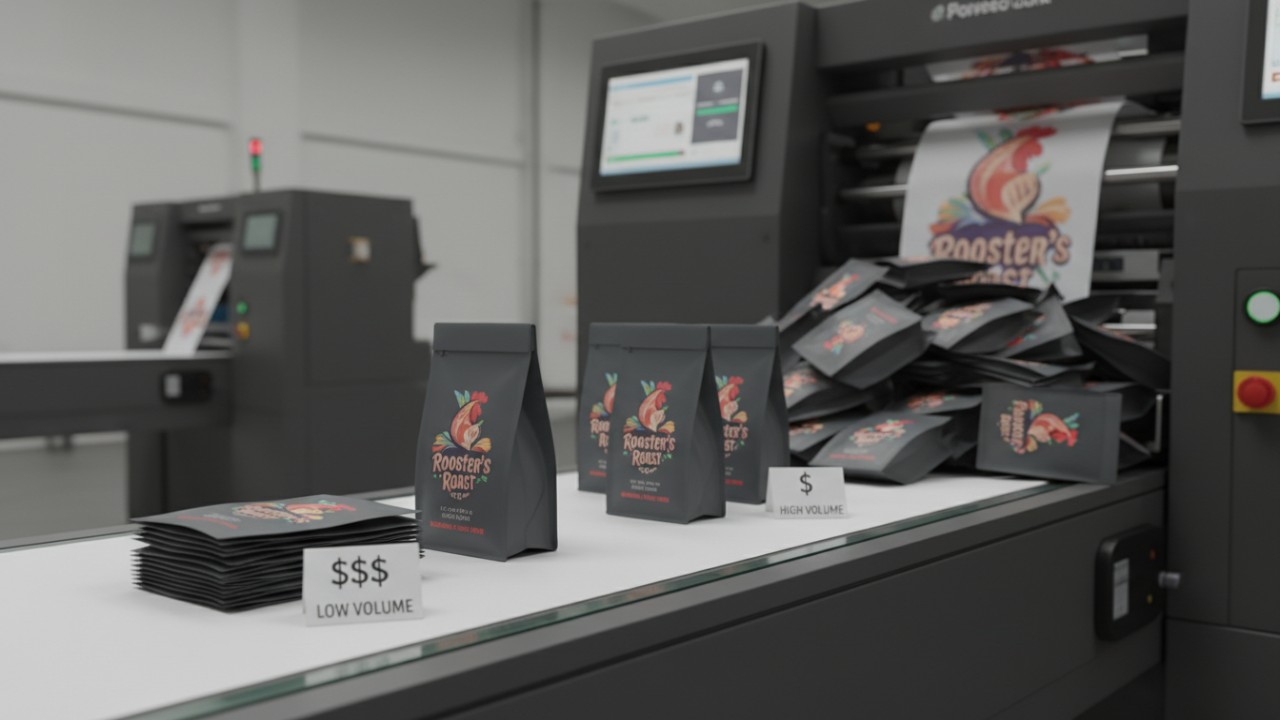
- Aggregate Volume: Combine 10 SKUs of 1,000 units into a single 10,000-unit run.
- Diverse Portfolios: Economically viable for brands with 50+ product variations.
- Unified Pricing: Benefit from volume discounts even on niche SKUs.
6. Cost-Efficient Market Testing & Prototyping
Digital technology allows brands to print production-quality prototypes and micro-batches (e.g., 500 units) for market testing without the financial risk of a full production run. This capability enables A/B testing of designs or flavors in real-world retail environments before committing to large volumes.
Traditional rotogravure or flexo printing makes market testing expensive due to high minimums. With digital, Winpack helps clients validate concepts cheaply. If a product fails a market test, the loss is limited to a small batch of packaging rather than a warehouse full of unsellable goods.
- A/B Testing: Test two different headline colors to see which converts better.
- Investor Samples: Create retail-ready mockups for buyer meetings.
- Regional Trials: Test a product in one specific city before a national rollout.
7. Marketing Integration: Variable Data Printing (VDP)
Variable Data Printing (VDP) turns packaging into a dynamic marketing channel by allowing every individual pouch to feature unique text, graphics, or QR codes without slowing down the press. This transforms packaging from a passive container into an active tool for customer engagement and supply chain tracking.
Brands can run "Golden Ticket" promotions, serialize products for anti-counterfeiting, or personalize messages for specific customers. This adds immense value and unlocks variable data printing packaging benefits that analog methods simply cannot match.
- Traceability: Unique serial numbers for supply chain transparency.
- Engagement: Unique QR codes for loyalty program scanning.
- Personalization: Print customer names or regional imagery on each pack.
8. Regulatory Agility: Label Changes Without Reprints
Digital workflows allow for instant updates to ingredient lists and compliance text in the digital art file, preventing the costly need to over-label or reprint entire batches due to regulatory shifts. As FDA or EU regulations evolve, the ability to pivot immediately protects your bottom line.
Rather than paying for manual labor to apply correction stickers to thousands of pouches—a process that destroys margins—digital printing allows you to correct the file and print a compliant batch immediately. This agility is a key component of inventory carrying cost reduction.
- Instant Compliance: Update nutritional facts in minutes.
- Global Adaptation: Easily switch languages for different export markets.
- Labor Savings: Eliminate the cost of manual sticker application.
9. Supply Chain Warehousing & Logistics Fees
By keeping physical inventory levels low through on-demand printing, brands significantly reduce monthly warehousing fees and the internal labor required to manage complex stock. Warehousing isn't just about rent; it involves handling fees, climate control costs, and the administrative burden of tracking pallets.
According to the Flexible Packaging Association, optimizing supply chain logistics is crucial for sustainability and cost control. Digital printing aligns production with consumption, meaning you store products, not packaging materials.
- Reduced Overhead: Lower monthly storage bills.
- Handling Efficiency: Less time spent moving pallets of unused materials.
- Space Allocation: Use your facility for production rather than storage.
10. Sustainability Savings: Waste & Disposal Fees
Digital printing reduces waste disposal fees by generating significantly less setup waste—measured in meters rather than the kilometers of film often wasted in flexographic press make-readies. Additionally, the precise nature of digital production means fewer excess units are printed and subsequently thrown away.
Sustainability is increasingly a financial metric. By reducing material waste, brands lower their carbon footprint and avoid potential future carbon taxes. As reported by Smithers, the shift toward digital is driven partly by these efficiency gains which support a better sustainable packaging total cost of ownership.
- Material Efficiency: drastically reduced setup waste.
- Disposal Costs: Lower dumpster and hauling fees.
- Green Premium: Appeal to eco-conscious consumers without expensive additives.
Expert Tips: Avoiding Common Digital Packaging Mistakes
To maximize ROI, brands must design specifically for the digital gamut and understand the pricing implications of heavy ink coverage. Digital printing is not a 1:1 replacement for flexo; it requires a tailored approach.
- Tip 1: Avoid heavy solids. Digital pricing is often based on ink consumption. Heavy, dark backgrounds can increase the cost per unit.
- Tip 2: Use the digital gamut. Digital presses can hit colors that traditional CMYK cannot. Design to this strength.
- Tip 3: Partner wisely. Ensure your converter, like Winpack, uses the latest HP Indigo or inkjet technology for consistent color management.
Future Outlook: Digital Packaging Trends for 2026
The future of digital packaging lies in AI-driven personalization at scale and the integration of smart technologies like RFID directly into the print workflow. By 2026, we anticipate that advancements in digital ink technology will lower costs further, making medium runs (20,000-50,000 units) increasingly competitive against flexo.
As the Flexible Packaging Association notes, the demand for sustainable and smart packaging solutions continues to drive innovation in this sector. Brands that adopt these technologies early will secure a significant competitive advantage.
Conclusion
Digital printing is more than just a production method; it is a comprehensive financial strategy that liberates cash flow, minimizes risk, and accelerates growth. By eliminating plate fees, reducing inventory drag, and enabling rapid market response, digital flexible packaging offers a superior Total Cost of Ownership for modern brands. From startups to enterprise CPGs, the shift to digital is a shift toward a more agile, profitable supply chain.
Contact us today to optimize your digital flexible packaging ROI and request a free quote.
FAQ
Is digital printing cheaper than flexo for flexible packaging?
For short to medium runs (typically under 20,000 units), digital is significantly cheaper due to the complete elimination of upfront plate costs. While flexo may have a lower "per unit" price on very long runs, digital often wins on Total Cost of Ownership when factoring in reduced inventory and waste.
What is the minimum order quantity (MOQ) for digital flexible packaging?
Digital printing allows for extremely low MOQs, often as low as 500 to 1,000 pouches per SKU. This is a sharp contrast to flexographic printing, which often requires commitments of 10,000 to 20,000 units per design to justify the setup.
How does digital printing reduce inventory costs?
It enables "Just-in-Time" ordering, meaning brands can order only what they need for the current month rather than tying up capital in six months of stock. This directly impacts inventory carrying cost reduction by lowering storage fees and preventing obsolescence.
Can digital printing handle food-safe flexible packaging?
Yes, modern digital presses (such as the HP Indigo 200K) use inks that are compliant with FDA and EU food safety regulations for indirect food contact. This ensures that short-run pouch printing costs do not come at the expense of safety or compliance.
What is the lead time for digitally printed pouches?
Digital production is exceptionally rapid, typically taking 10-15 business days from artwork approval to shipping. This is significantly faster than the 6-12 weeks often required for conventional printing methods, allowing for greater speed-to-market.
Does digital packaging allow for recyclable materials?
Yes, digital printing works excellently on PE-PE recyclable films and post-consumer recycled (PCR) materials. The process itself generates less waste than analog methods, contributing to a better sustainable packaging total cost of ownership.
What is Variable Data Printing (VDP) in packaging?
VDP allows every single pouch to feature unique elements, such as serialized IDs, QR codes, or individualized names, without stopping the press or incurring extra setup costs. This unlocks powerful variable data printing packaging benefits for marketing and traceability.
When should I switch from digital to flexo printing?
The switch is usually recommended when volumes per SKU regularly exceed 25,000 to 50,000 units, where the lower per-unit cost of flexo begins to outweigh the setup fees. However, many brands maintain a hybrid strategy, using digital for seasonal or test items and flexo for core high-volume products.


Folding Boxes
Can I get a sample before placing a formal order?
Samples usually require a certain fee, but this fee can be partially or fully refunded after the customer confirms the order.
About Printing Craftsmanship
What factors should I consider when choosing a printing technique?
Material: Some methods work better on specific surfaces (e.g., screen printing for fabric, offset for paper).
Budget: Offset is cost-effective for large runs, while digital printing is better for short runs.
Aesthetic & Finish: If you need metallic effects, choose hot stamping; for texture, consider embossing.
Durability: UV printing and screen printing offer long-lasting prints resistant to fading.
Special Shape Boxes
How long does it usually take from design confirmation to delivery?
The lead time is usually 15-25 days, depending on the production of the order
Rigid Magetic Boxes
Can I order a sample of my packaging box?
Yes, we strongly recommend that you do so, we provide a variety of sample types to meet different usage situations and help you guarantee the best results!
About Us
How to start the mass production?
Once received the 30% deposite, we will arrange the mass prouction.The balance need to be paid before delivery.


Start Your Packaging Journey Today
Discover Our Curated Collection of Bespoke Packaging Cases & Tailored System Solutions
© 2025 WINPACK PRINTING. All rights reserved

Wenhua Printing packaging
winpackprinting
Winpack Printing