




Eco-Friendly Takeaway Boxes: The Definitive Ranking of Sustainable Packaging for 2026
- Introduction: The 2026 Tipping Point for Food Service Packaging
- Navigating the Regulatory Storm: Key Laws Affecting You
- EU PPWR (Packaging & Packaging Waste Regulation)
- California SB 54: The American Benchmark
- Labeling Compliance and Greenwashing
- Material Showdown: Sugarcane Bagasse vs. Unbleached Kraft Paper
- Temperature Tolerance and Durability
- Grease & Moisture Resistance
- End-of-Life: Composting vs. Recycling
- Cost-Benefit Analysis for Restaurant Owners
- Unit Cost Comparison
- Hidden Costs: The "Double-Cupping" Effect
- Supply Chain and Lead Times
- B2B Procurement Guide: How to Source Successfully
- MOQ (Minimum Order Quantity)
- Sample Request Protocol
- Certification Verification
- Conclusion
- FAQs
The food service industry stands at a precipice. For the last decade, switching to eco-friendly packaging was a marketing decision—a way to signal virtue to environmentally conscious consumers. However, as we look toward the horizon, the landscape has fundamentally shifted.
We are entering the era of compostable food packaging 2026. This year marks a critical convergence of strict government mandates, supply chain realignments, and material innovation. The choice between materials, specifically sugarcane bagasse vs kraft paper, is no longer just about which container looks better on Instagram; it is a strategic decision regarding regulatory compliance and functional viability.
This guide provides an authoritative look at the 2026 tipping point, specifically focusing on PFAS-free takeaway containers, the regulatory heavyweights in the EU and US, and how restaurant owners and wholesalers can navigate this transition without sacrificing profitability.
Introduction: The 2026 Tipping Point for Food Service Packaging
Why is 2026 the date on every packaging manufacturer’s calendar? It represents the "point of no return" for the elimination of Per- and Polyfluoroalkyl Substances (PFAS). Often termed "forever chemicals," PFAS have historically been used to coat paper and fiber containers to provide grease resistance. However, their persistence in the environment and links to adverse health effects have triggered a global legislative crackdown.
By 2026, the grace periods for many regional bans will expire. We are witnessing a massive shift from voluntary sustainability to mandatory compliance. Major markets are enforcing strict penalties for non-compliance, forcing the entire supply chain—from biodegradable food service ware wholesale distributors to the local coffee shop—to adapt immediately.
In this high-stakes environment, two materials have emerged as the primary contenders to replace plastic and PFAS-laden fibers: Sugarcane Bagasse and Unbleached Kraft Paper.
· Sugarcane Bagasse: A molded fiber favored for hot, wet, and heavy meals.
· Kraft Paper: A sturdy, folded paper solution dominant in the dry and cold food sectors.
Understanding the nuance between these two is key to surviving the regulatory storm.
Navigating the Regulatory Storm: Key Laws Affecting You
Ignorance of the law is no longer a defense. The regulatory framework governing sustainable packaging has become a complex web of international and state-level directives. To operate successfully in 2026, you must understand the following legislative pillars.
EU PPWR (Packaging & Packaging Waste Regulation)
In the European Union, the EU Packaging and Packaging Waste Regulation (PPWR) is the gold standard of legislative ambition. This regulation is not merely a suggestion; it is a comprehensive overhaul of how packaging is designed, used, and disposed of.
The PPWR pushes aggressively for all packaging to be 100% recyclable by 2030, but the 2026 milestones are critical for the food service sector. The regulation mandates significant reductions in packaging waste and enforces strict bans on intentionally added PFAS in food contact materials. For businesses exporting to or operating within the EU, this means that any claim of "biodegradability" must be backed by certified industrial compostability standards. The days of vague green claims are over; under sustainable packaging regulations EU US, precise compliance is the only way forward.
California SB 54: The American Benchmark
Across the Atlantic, California continues to lead the United States in environmental policy. The California SB 54 (Plastic Pollution Prevention Act) is a landmark piece of legislation that shifts the burden of waste management from the taxpayer to the producer.
Known as an Extended Producer Responsibility (EPR) law, SB 54 requires producers to reduce single-use plastic by at least 25% by 2032, with significant benchmarks hitting in 2026. Crucially, it redefines what can be considered "recyclable" or "compostable." If a material cannot be effectively processed by existing infrastructure in California, it cannot be labeled as such. This drives the market toward PFAS-free takeaway containers that have proven end-of-life pathways, such as certified fiber-based solutions.
Labeling Compliance and Greenwashing
With these regulations comes a crackdown on "greenwashing." Terms like "eco-friendly" or "earth-safe" are now legally risky if undefined. Regulatory bodies are demanding third-party verification.
· BPI (Biodegradable Products Institute): In North America, this is the standard for compostability (ASTM D6400).
· OK Compost (TÜV AUSTRIA): The European equivalent (EN 13432).
Failing to secure these certifications while making environmental claims can result in substantial fines and the removal of products from the market.
Material Showdown: Sugarcane Bagasse vs. Unbleached Kraft Paper
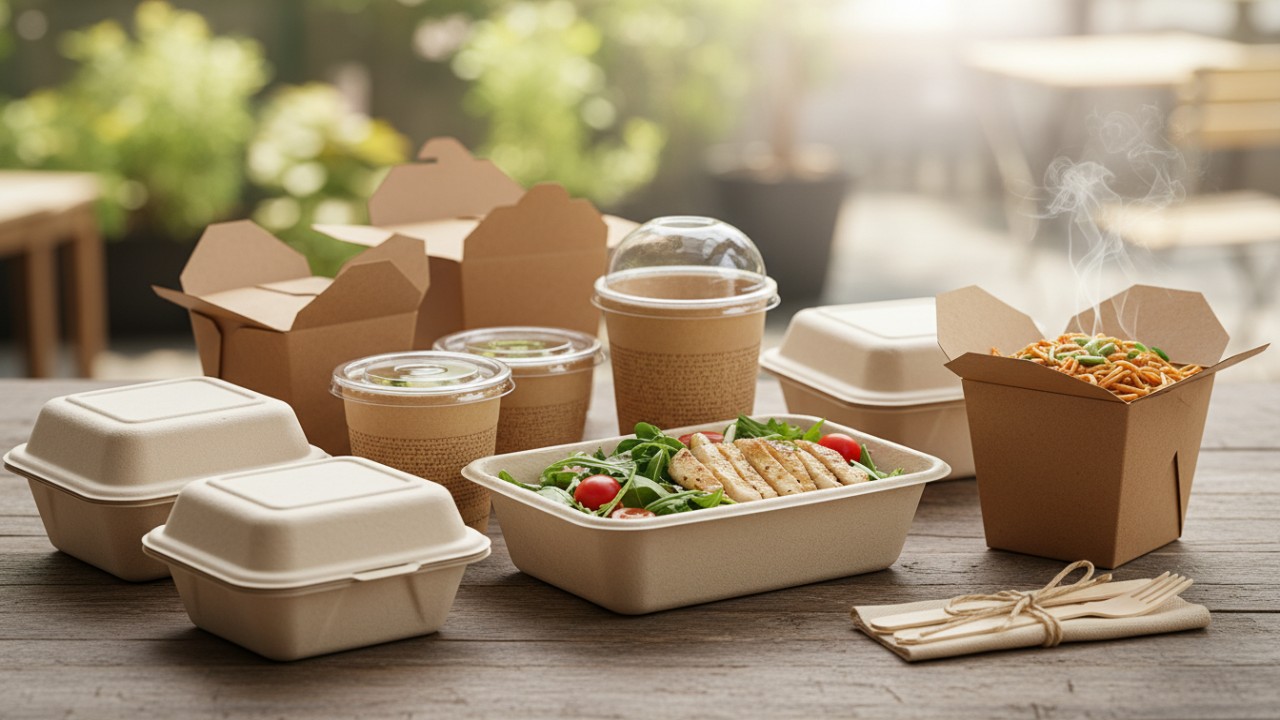
When selecting compostable food packaging 2026, the decision often narrows down to molded fiber (Bagasse) versus folded paper (Kraft). While both are sustainable improvements over plastic, they serve different functional roles.
Temperature Tolerance and Durability
The physics of the materials dictate their usage.
|
Feature |
Sugarcane Bagasse |
Unbleached Kraft Paper (Poly-lined) |
|
Heat Resistance |
Up to 200°F (93°C) |
Low to Medium (Risk of warping) |
|
Microwave Safe |
Yes (Excellent) |
No (Usually contains PE/PLA lining) |
|
Structure |
Rigid, Molded |
Flexible, Folded |
|
Best For |
Hot Soups, Curries, Heavy Rice |
Sandwiches, Salads, Dry Bakeries |
Bagasse is a byproduct of sugarcane processing. It is molded under high heat and pressure, resulting in a container that acts like a thermos. It is thick, insulative, and can handle the microwave without deforming.
Kraft Paper, while aesthetically pleasing with its natural brown look, typically requires a lining (PLA or PE) to hold liquids. Standard Kraft paper loses structural integrity when exposed to high heat or steam, making it unsuitable for the hottest menu items.
Grease & Moisture Resistance
This is where the sugarcane bagasse vs kraft paper battle is usually decided.
· The Wet Test: For restaurants serving oily foods, sauces, or gravies, Bagasse is the superior choice. High-quality Bagasse is treated (increasingly with PFAS-free agents) to resist grease penetration for extended periods. It absorbs condensation without collapsing.
· The Dry Test: Kraft paper excels in the "dry/cold" sector. For a burger, a wrap, or a salad, Kraft paper provides a crisp, clean presentation. However, if you put a hot curry in a standard Kraft bowl, the steam may weaken the glues or the paper structure, leading to leaks.
End-of-Life: Composting vs. Recycling
Disposal is a key component of sustainable packaging regulations EU US.
· Bagasse: Designed for industrial composting. It breaks down into biomass. However, if it is heavily soiled with food, it cannot be recycled in standard paper streams.
· Kraft Paper: If it is unlined and clean, it is highly recyclable. However, most takeaway Kraft containers have plastic or bioplastic linings (PLA) to prevent leaking. These lined containers generally cannot be recycled with standard cardboard and must be sent to industrial composting facilities, provided the lining is also certified.
Cost-Benefit Analysis for Restaurant Owners
Switching to PFAS-free takeaway containers implies a cost structure change. However, smart procurement can mitigate these costs.
Unit Cost Comparison
Historically, generic plastic was the cheapest option. In the sustainable realm:
· Kraft Paper is generally the "Economy" option for dry foods. The manufacturing process (folding paper) is faster and less energy-intensive than molding fiber.
· Bagasse commands a "Premium." The molding process is slower, and the material is denser.
However, the gap is narrowing as biodegradable food service ware wholesale scales up to meet the 2026 demand.
Hidden Costs: The "Double-Cupping" Effect
When analyzing costs, one must look beyond the price per carton. A common mistake restaurant owners make is buying the cheapest paper bowl, only to find it gets soggy within 15 minutes. This forces staff to "double-cup" (use two bowls for one order) to prevent customer complaints.
· Scenario A: Cheap Kraft Bowl ($0.10) x 2 = $0.20 per order.
· Scenario B: Premium Bagasse Bowl ($0.16) x 1 = $0.16 per order.
In this scenario, the "expensive" Bagasse option is actually 20% cheaper per served meal, whilst also reducing waste volume.
Supply Chain and Lead Times
Bagasse production is concentrated in regions where sugarcane is grown (primarily Asia and South America). This can lead to longer shipping times compared to Kraft paper, which is produced globally. As the 2026 mandates approach, demand for certified Bagasse is expected to outstrip supply, potentially driving prices up. Locking in contracts now is a prudent financial move.
B2B Procurement Guide: How to Source Successfully
For distributors and large restaurant chains, sourcing biodegradable food service ware wholesale requires a strategic approach.
MOQ (Minimum Order Quantity)
· Stock Items: Wholesalers often have low MOQs (e.g., 1 pallet) for standard unprinted items.
· Customization: If you want your logo on the packaging, the game changes.
o Kraft: Easier to print on. MOQs are moderate (e.g., 30,000 units).
o Bagasse: Difficult to print directly on the fiber due to texture. Branding is usually done via embossing (mold change) or stickers/sleeves. Embossing requires high MOQs (often 50,000+ units) to justify the mold cost.
Sample Request Protocol
Never buy a container based on a PDF spec sheet. You must stress-test the PFAS-free takeaway containers with your specific menu items.
1. The Hot Oil Test: Pour hot oil (or your oily sauce) into the sample. Let it sit for 30 minutes. Check the bottom for staining.
2. The Microwave Test: Microwave the food in the container for 3 minutes. Does it warp? Does it become too soft to hold?
3. The Lid Fit: Ensure the lid snaps on tight. Fiber lids on fiber bases can sometimes be loose if manufacturing tolerances aren't tight.
Certification Verification
Before signing a contract, demand to see the Biodegradable Products Institute (BPI) Certification or OK Compost certificates. Verify the certificate number on the certifying body's website. There are many counterfeit certificates in circulation. Ensuring the manufacturer holds a valid, active certificate is the only way to protect your business from regulatory fines under the new laws.
Conclusion
As we approach 2026, the choice between Sugarcane Bagasse and Kraft Paper isn't just about aesthetics—it's about regulatory survival and functional performance. The convergence of the EU PPWR and California SB 54 signals the end of the unregulated plastic era.
Bagasse remains the undisputed leader for hot, heavy meals requiring PFAS-free grease resistance, offering a robust, microwave-safe solution. Meanwhile, Kraft Paper continues to dominate the dry food sector, offering cost-effective branding opportunities. For business owners, the priority now is securing BPI-certified supply chains before the new mandates disrupt availability. The transition to compostable food packaging 2026 is inevitable; the businesses that adapt their procurement strategies today will be the market leaders of tomorrow.
Request your samples today to ensure your packaging is future-proof.
FAQs
What is the difference between 'Biodegradable' and 'Certified Compostable'?
'Biodegradable' is a vague marketing term meaning a material breaks down eventually, possibly taking decades and often leaving microplastics. 'Certified Compostable' (e.g., BPI or OK Compost) guarantees the product decomposes into nutrient-rich soil within 90-180 days under specific industrial conditions, meeting strictly defined standards like ASTM D6400.
Can Sugarcane Bagasse containers be used in the microwave?
Yes, high-quality Bagasse containers are microwave-safe and can typically withstand temperatures up to 200°F (93°C) without releasing toxins or deforming, making them superior to most plastic or coated paper options.
Does the 2026 PFAS ban apply to all takeaway packaging?
Most major jurisdictions (including the EU and states like California, New York, and Washington) have bans targeting intentionally added PFAS (forever chemicals) in food contact materials taking full effect by 2026. You must verify supplier certifications to ensure compliance.
If you have further questions or require a professional packaging solution, please feel free to contact us at any time.
What is the difference between biodegradable and compostable takeaway boxes?
The term "biodegradable" is vague and simply means a material will break down eventually, potentially leaving behind microplastics or taking decades. "Compostable" is a regulated term (often certified by standards like ASTM D6400 or EN 13432) meaning the item will break down into nutrient-rich soil within a specific timeframe, usually 90 days, under the right environmental conditions.
Are Kraft takeaway boxes microwave safe?
Yes, most high-quality Kraft takeaway boxes are microwave safe. However, you must ensure they do not feature any metal handles (common in Chinese takeout pails) or non-heat-safe plastic linings. Always check the manufacturer's specification for heat tolerance to avoid warping or chemical leaching.


OEM Services
What is OEM packaging, and how can Winpack Printing help?
OEM (Original Equipment Manufacturer) packaging refers to custom-designed packaging solutions tailored to a brand’s specifications. At Winpack Printing, we provide end-to-end OEM services, including design, proofing, printing, and production, to help you create high-quality, market-ready packaging that aligns with your brand identity.
What is the minimum order quantity (MOQ) for OEM orders?
Our MOQ varies depending on the type of packaging and material used. We offer flexible MOQ options to accommodate both small businesses and large-scale manufacturers. Contact us for a tailored quote based on your needs.
How long does the production process take?
Production time depends on order quantity, complexity, and customization. Generally, the process takes 7-20 days after design confirmation and sample approval. We strive for fast turnaround times while maintaining high-quality standards.
Special Shape Boxes
Can I get a sample before placing an official order?
Yes, we provide samples to our customers. Please contact our sales team to inquire about sample availability and pricing.
Rigid Lift-off Box
What are the wholesale pricing options for bulk orders?
We offer competitive wholesale prices for bulk orders. Please contact our sales team for more details


Start Your Packaging Journey Today
Discover Our Curated Collection of Bespoke Packaging Cases & Tailored System Solutions
© 2025 WINPACK PRINTING. All rights reserved

Wenhua Printing packaging
winpackprinting
Winpack Printing