




What is Flexographic Printing?
If you're in the printing business or a company looking to package your products in boxes, you've probably heard the term 'flexography' without knowing what it means.
The flexographic printing press is a technique believed to be the new letterpress because it can print on large volumes of substrates, such as:
Plastic
Paper
metals
films
cellophane.
Flexographic printing press technology is economical in terms of time and cost-effective, offering a wide variety of choices.
Flexo printing offers high-quality results at an affordable price, whether you need to print food packaging or labels.
Now, let's take a closer look at the flexographic printing process and how you can use this technology to your advantage.
- 1. Flexo printing development
- 2. The flexographic printing process
- 3. The strengths and weaknesses of flexographic printing
- --The benefits of flexographic printing
- --However, flexographic printing has its cons
- 4. The ecological impact of flexography printing
- 5. Flexography vs. offset
- 6. Flexographic Packaging and Printing Design
1. Flexo printing development
This digital technology is one of the greatest developments in flexography.
It has increased the efficiency of the printing process and improved turnaround time and accuracy.
Digital imaging technology enables the creation of high-quality images with vivid colours and clear detail.
This has created new opportunities for flexography, such as printing on more materials and creating more intricate designs.
In addition to digital technology, sustainability enhancements have also played a key role in the development of flexography.
Most printers currently use environmentally friendly flexographic printing inks, which are less harmful to the environment than solvent-based inks.
These inks are produced using natural materials and renewable resources, and do not contain any harmful chemicals that could damage the environment.
2. The flexographic printing process
The key operations of flexographic printing are as follows:
- Image preparation
- Flexible plate making
- Mounting
- Printing
- Finishing
The selected material or substrate is mounted on a roll and run through a sequence of rotary flexible relief plates.
Each flexible printing plate is fed with a single colour of ink by a special roller.
Each colour has its own flexible printing plate, and all the plates can be used interchangeably to produce all the colours in the final printed product.
The best thing about flexo printing is that you can add special finishes to the process, including:
These processes can be incorporated into the printing process to complete the job in one go.
The viscosity of flexographic inks is low, and they are deposited on the surface of substrates as part of the process until they solidify.
Although this might be easy to understand, flexographic printing is not that straightforward because various alternatives come into play.
Flexographic printing has evolved rapidly over the years to accommodate a range of printing options.
These options can be categorised as follows:
Traditional flexo: In this method, doctor blades are used to clean up excess ink, apply solvent-based ink to the plates, and ensure that the colour is evenly applied when it comes into direct contact with the substrate.
Enhanced flexo: This improved version of conventional flexo uses central impression cylinders to create sharp images to a much higher standard. It is also cheaper than conventional flexo.
3. The strengths and weaknesses of flexographic printing
--The benefits of flexographic printing
It can print on absorbent and non-absorbent materials. It can print images on plastics, brown paper, acetate films, corrugated boards, fabrics and cellophane. It can also effectively print brilliant, continuous, high-quality patterns.
It applies a very diverse range of inks. It can use water-based, UV-curable and solvent inks, all of which dry incredibly quickly, making the process sustainable and time-saving.
It is a highly flexible process. It can print millions of impressions and support a wide range of cylinder repeat lengths to suit customer requirements.
It is inexpensive and efficient. Compared to rival processes, this method is less expensive because it results in faster production due to its high-speed process and flexographic inks.
--However, flexographic printing has its cons
Generic printing: Flexo printing cannot produce the same level of detail as other printing types, such as offset printing.
Expensive equipment and materials: The printing plates are expensive because they have to be purchased separately in various colours. Wrapping and distorting images is also costly.
Short-run abilities are lacking: Unlike digital printing, this form of printing is not usually practical for small quantities or sampling because it involves a set-up procedure.
4. The ecological impact of flexography printing
As with any other printing process, flexography printing affects the environment.
The flexographic printing process consumes a lot of energy and produces waste such as unused ink, flexographic printing plates and packaging materials. It also employs chemicals which may be detrimental to the environment and human health.
Water consumption is also an issue, as a lot of water is needed to wash flexographic printing plates and equipment.
Nevertheless, the adverse environmental effects of flexographic printing can be reduced by taking the following steps.
These include using eco-friendly flexographic printing inks and solvents, minimising waste and recycling, embracing energy-saving equipment and processes, and conserving water.
By taking these steps, flexographic printers will be able to minimise their environmental impact and help to make the printing industry more sustainable.
5. Flexography vs. offset
Both flexographic and offset printing are equally good, and often it is impossible to tell the difference between the finished products.
However, it is important to understand the differences between these printing methods to ensure that the right technology is used for each project.
The main differences between flexographic and offset printing are:
Flexography uses rotary flexible plates to print directly onto a substrate, rather than printing indirectly through a set of offset plates.
Unlike offset printing, where finishes such as die-cutting, folding and lamination are added after the printing process, flexography adds special finishes and operations in a single pass.
Offset printing can only be used on smooth or flat surfaces, and porous and absorbent materials require additional processes to achieve good results. Flexography, on the other hand, can print on virtually any substrate.
Flexographic printing can offer significant economies of scale by incorporating additional processes in a single pass, whereas offset printing can be expensive and time-consuming.
6. Flexographic Packaging and Printing Design
As discussed above, flexography has given us a wide range of abilities.
However, flexographic printing requires various design considerations, particularly in relation to labels and packaging.
The quality of your finished product's printing may depend on your design and file preparation. While this is true of any printing process, it is particularly important to consider these specifications when designing.
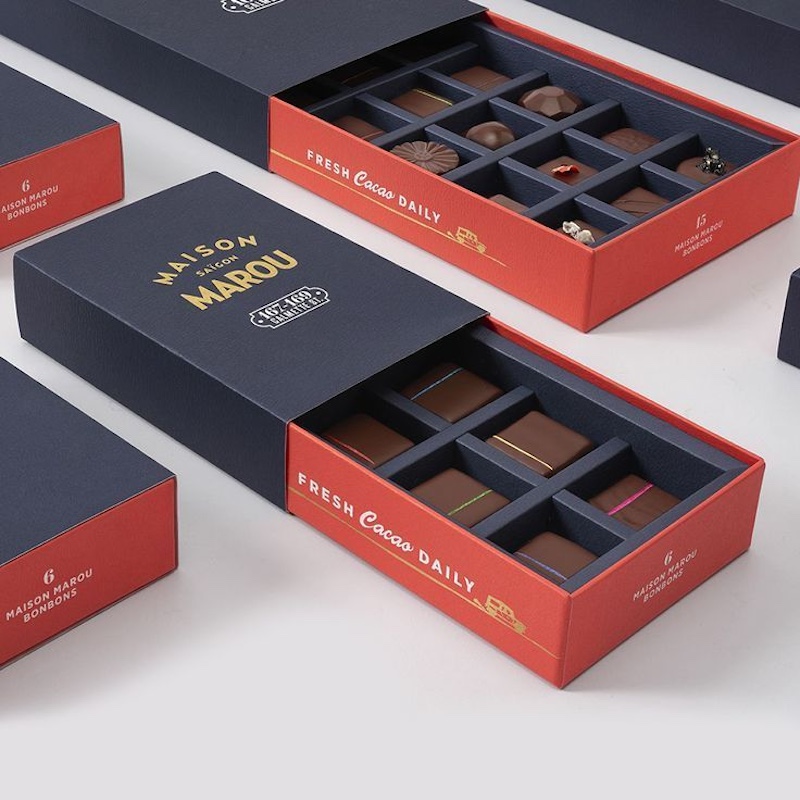
--Packaging materials
Although flexographic printing can be used on a wide variety of substrates, a non-porous material is recommended to ensure rapid drying and curing.
Porous materials can also affect the readability of text since the ink is absorbed by the substrate.
To convey information clearly on your packaging, it is best to use flexible and smooth packaging materials.
--Text and numbers
Choose a decent font size to make the information printed on the packaging material (e.g. natural kraft) easy to read.
The smallest font size is between 4 and 10 point, as is the case with most materials.
Although this is a very large size range, the typeface you choose also affects the font size.
Remember that, in certain cases, sans serif fonts may appear smaller, whereas serif fonts must be a bit bigger to be readable.
Find out more about fonts for custom packaging.
--Artwork designs
Minimalist designs using blocks of colour are best because they require only a few flexible rotary plates to produce quality results.
Complicated designs are also expensive, since every colour requires a separate plate in the flexographic printing process.
Complicated designs are best suited to offset printing, as this becomes more economical per unit of packaging.
Want to find out more about printing your product? Contact our product specialists now!


Rigid Drawer Box
Can you provide me with a die-cutting line template?
We will provide a die-cutting line template after you place an order for samples or products.
What are the wholesale pricing options for bulk orders?
We offer competitive wholesale prices for bulk orders. Please contact our sales team for more details
Special Shape Boxes
Can I order a sample of my packaging box?
Yes, we strongly recommend that you do so, we provide a variety of sample types to meet different usage situations and help you guarantee the best results!
Rigid Magetic Boxes
Can I get a sample before placing an official order?
Yes, we provide samples to our customers. Please contact our sales team to inquire about sample availability and pricing.
About Us
What is the minimum order quantity for packaging?
1000 units. The MOQ is based on every unique box (e.g. size, design).

Start Your Packaging Journey Today
Discover Our Curated Collection of Bespoke Packaging Cases & Tailored System Solutions
© 2025 WINPACK PRINTING. All rights reserved

Wenhua Printing packaging
winpackprinting
Winpack Printing